IEC 60601 Stability Compliance Tool for Medical Carts
Overview
I built a MATLAB tool to give engineers quick stability feedback on medical cart designs during the development process — not to replace formal analysis, but to help catch issues early. Engineers had to wait days for an expert stability analysis every time they made a design change, which slowed down the entire development cycle.
Now, engineers can get instant preliminary feedback themselves. They input the cart and arm centers of mass, add any forces or moments, and immediately see if their current design is stable or unstable. This lets them explore many design options quickly and fix obvious stability problems before sending the design for official validation.
The tool handles all the complex calculations: checking tipping moments, testing different load cases from IEC 60601, and simulating various arm positions. By providing instant feedback during the design phase, engineers can iterate rapidly and arrive at the formal validation stage with designs that are much more likely to pass on the first try.
Key Features
- Simple input system: users input only essential parameters — cart center of mass, arm center of mass, caster positions, and any applied forces/moments. The tool handles all complex calculations internally.
- IEC 60601 compliance testing: automatically evaluates standard test cases including 10° inclination stability, emergency brake scenarios, user interaction forces (leaning, pushing), port loading conditions for surgical applications, and combined worst-case loading scenarios.
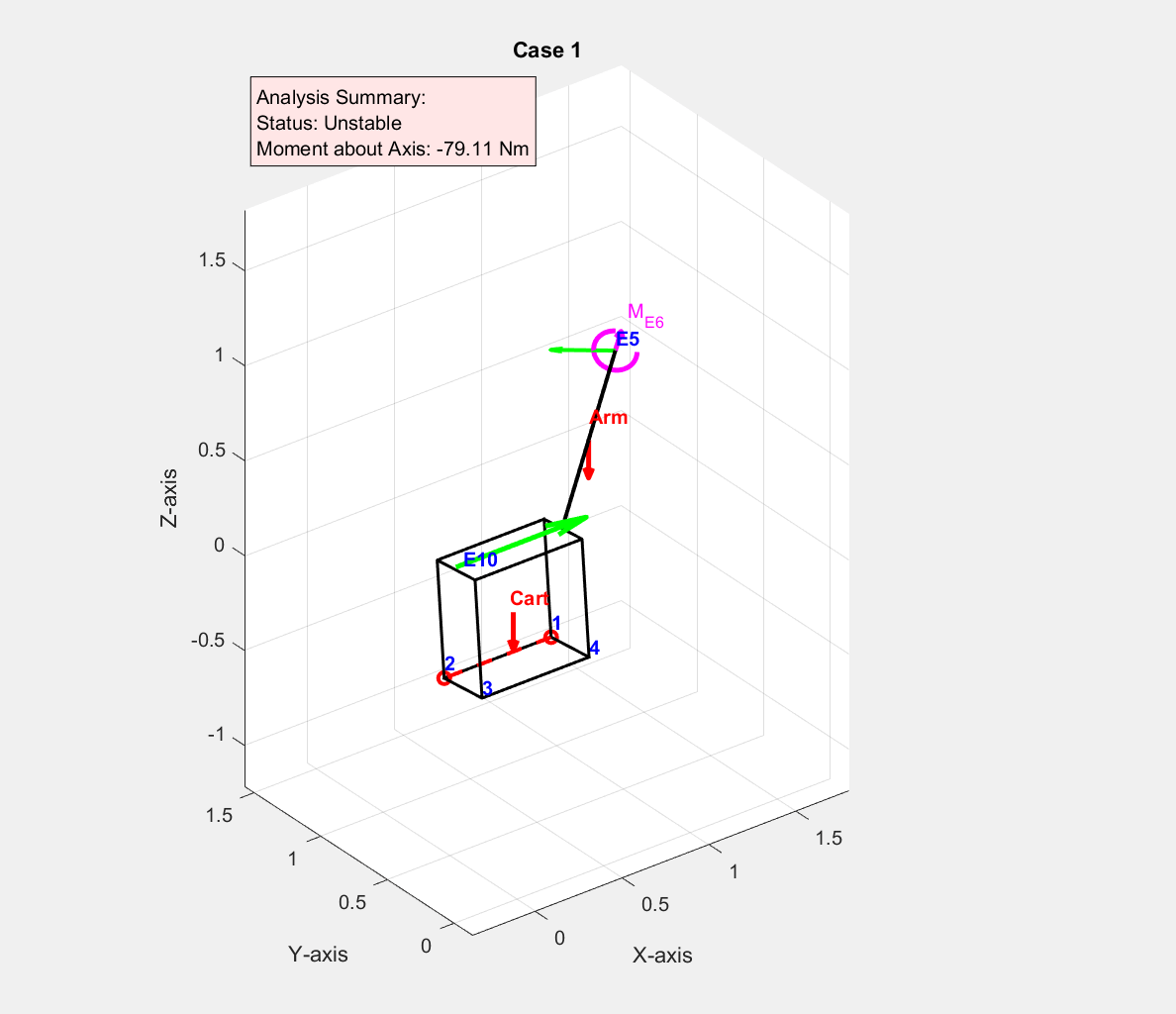
- Clear pass/fail output: definitive stability assessment ("Stable" or "Unstable") with quantitative stability margins in N·m.
- Rapid design iteration: enables engineers to quickly test multiple configurations and loading conditions.
- Visual verification: 3D visualization confirms proper load application and helps identify critical tipping scenarios.
Technical Implementation
The tool uses moment analysis about user-defined tipping axes, incorporating gravitational forces, external loads, and cart inclination. I implemented Rodrigues' rotation formula for slope calculations and 2D rotation matrices for arm kinematics, ensuring accurate force transformations under all orientations.